
Alexander Borodin
Alexander Borodin balanced two demanding lives as a scientist and composer, creating richly melodic Russian music including Prince Igor and the popular Polovtsian Dances.
Borodin wrote memorable music while also working professionally as a chemist and teacher.
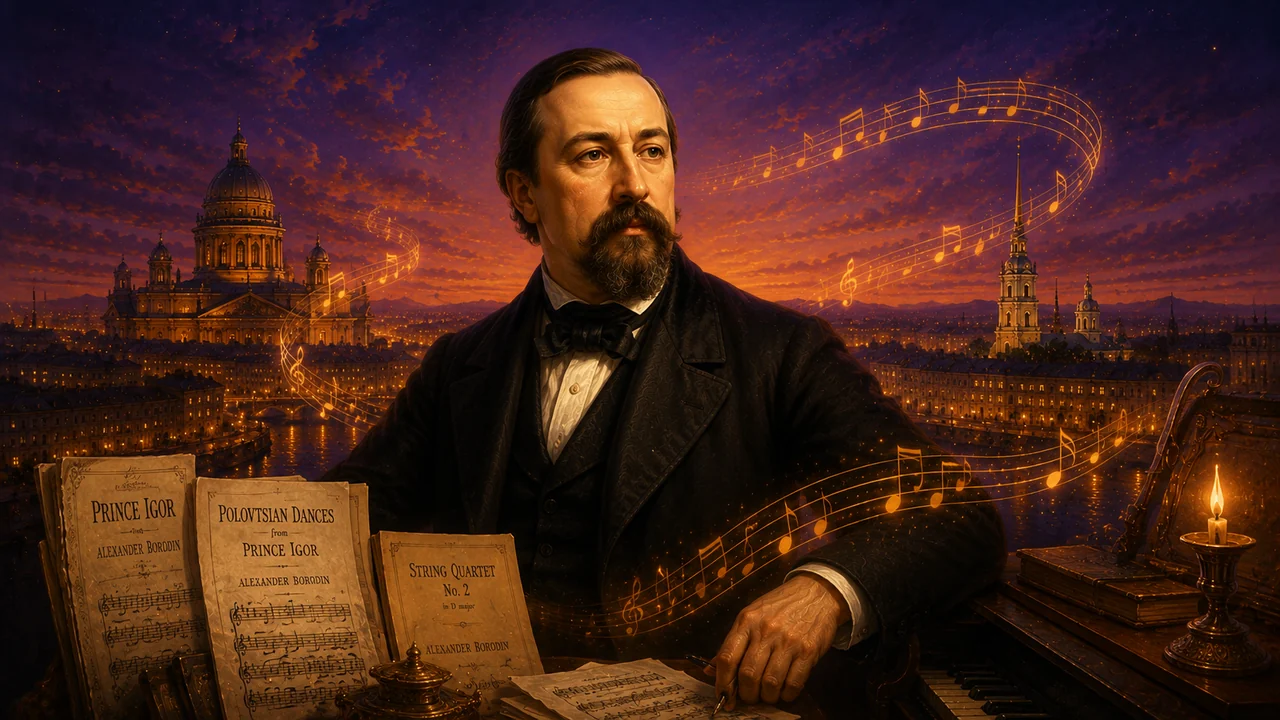
Life and Story
Alexander Borodin was born in Saint Petersburg in 1833. He trained in medicine and chemistry and pursued a serious scientific career, eventually becoming a professor. Music remained a major passion, and through Balakirev he became connected with The Five. Because scientific and academic duties took much of his time, Borodin composed slowly and left several projects incomplete. His music includes symphonies, chamber works, songs and the opera Prince Igor. The Polovtsian Dances from that opera became especially famous for their strong rhythms and sweeping melodies. Borodin also supported education for women in medicine and science. He died suddenly in 1887, and friends including Rimsky-Korsakov and Glazunov helped prepare unfinished music for performance.
Musical Style
Warm melodies, repeated rhythmic patterns and Russian or Central Asian color are common. His chamber music can be lyrical and carefully constructed, while dramatic works use bold orchestral gestures.
Why Are They Important?
Borodin became an important member of The Five despite composing alongside a full scientific career. His music contributed strongly to the international image of Russian Romanticism.
Why Study This Composer?
Borodin helps students hear broad melody, dance rhythm and rich harmonic color. His works are useful for comparing lyrical themes with strongly rhythmic sections.
What Can a Student Learn?
Students learn to shape long melodies, maintain rhythmic drive and hear how contrast between lyricism and dance can organize a large section.
Era and Contemporaries
Borodin worked alongside Mussorgsky and Rimsky-Korsakov in The Five while also participating in nineteenth-century Russian scientific life.
What to Listen For
In the Polovtsian Dances, identify a broad singing theme and then compare it with more strongly accented dance material. Notice how repetition increases excitement.
Memorable Facts
Featured Works
This section lists important works for reference. A score link appears only when Gamurland has completed both rights and score verification for that work.