
Sergei Rachmaninoff
Sergei Rachmaninoff carried the grand Romantic piano tradition into the twentieth century with expansive melody, rich harmony and some of the most demanding keyboard writing in the repertoire.
Rachmaninoff could make a piano sound both enormous and intensely lyrical.
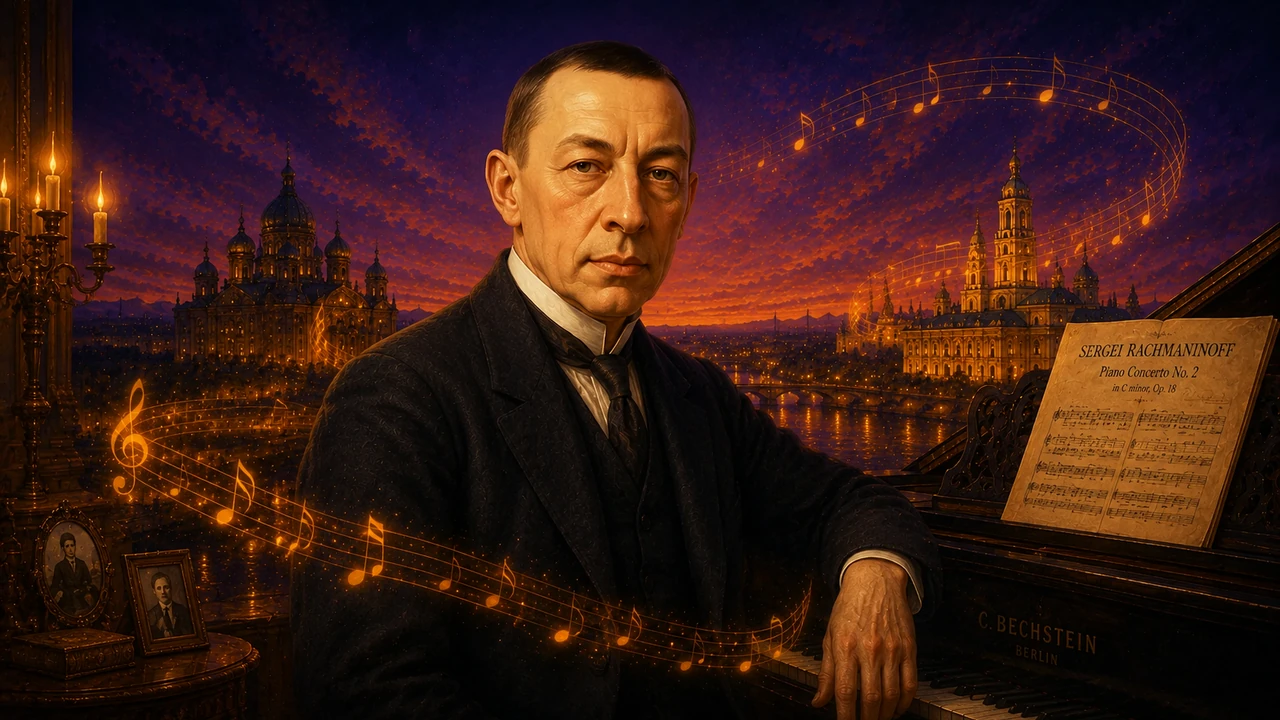
Life and Story
Sergei Rachmaninoff was born near Novgorod in 1873 and trained at the Moscow Conservatory. He became known as a pianist, composer and conductor. An early failure of his First Symphony deeply affected him, but he recovered and produced major works including the Second Piano Concerto. Rachmaninoff’s unusually large hands supported a formidable piano technique, yet his playing was admired for clarity as well as power. After the Russian Revolution of 1917 he left Russia permanently and eventually settled in the United States. To support his family he spent much of his later life touring as a pianist, which reduced his time for composition. His works include piano concertos, preludes, études, symphonies and vocal music. He died in Beverly Hills in 1943.
Musical Style
Broad melodies, bell-like sonorities, chromatic harmony and thick chordal textures are common. Even in virtuosic passages, a clear melodic line usually needs to remain audible.
Why Are They Important?
Rachmaninoff became one of the last great representatives of the Russian Romantic piano tradition while also leaving important recordings of his own playing.
Why Study This Composer?
Rachmaninoff teaches advanced students voicing through large chords, long phrase direction and control of dense textures. Simpler preludes and arrangements can introduce his harmonic style.
What Can a Student Learn?
Students learn to organize large hand movements, separate melody from dense accompaniment and build long climaxes without forcing the sound.
Era and Contemporaries
Rachmaninoff’s life spans late Imperial Russia, emigration after 1917 and the international concert world of the early twentieth century.
What to Listen For
In the Second Piano Concerto, follow one broad melody through the thick piano and orchestral texture. In a prelude, listen for bell-like chords and long harmonic tension.
Memorable Facts
Featured Works
This section lists important works for reference. A score link appears only when Gamurland has completed both rights and score verification for that work.