
Alexander Scriabin
Alexander Scriabin began in a highly Romantic piano language and gradually developed a strikingly personal harmonic world connected with color, symbolism and mystical ideas.
Scriabin’s music lets students hear how a familiar Romantic piano sound can gradually become something much less predictable.
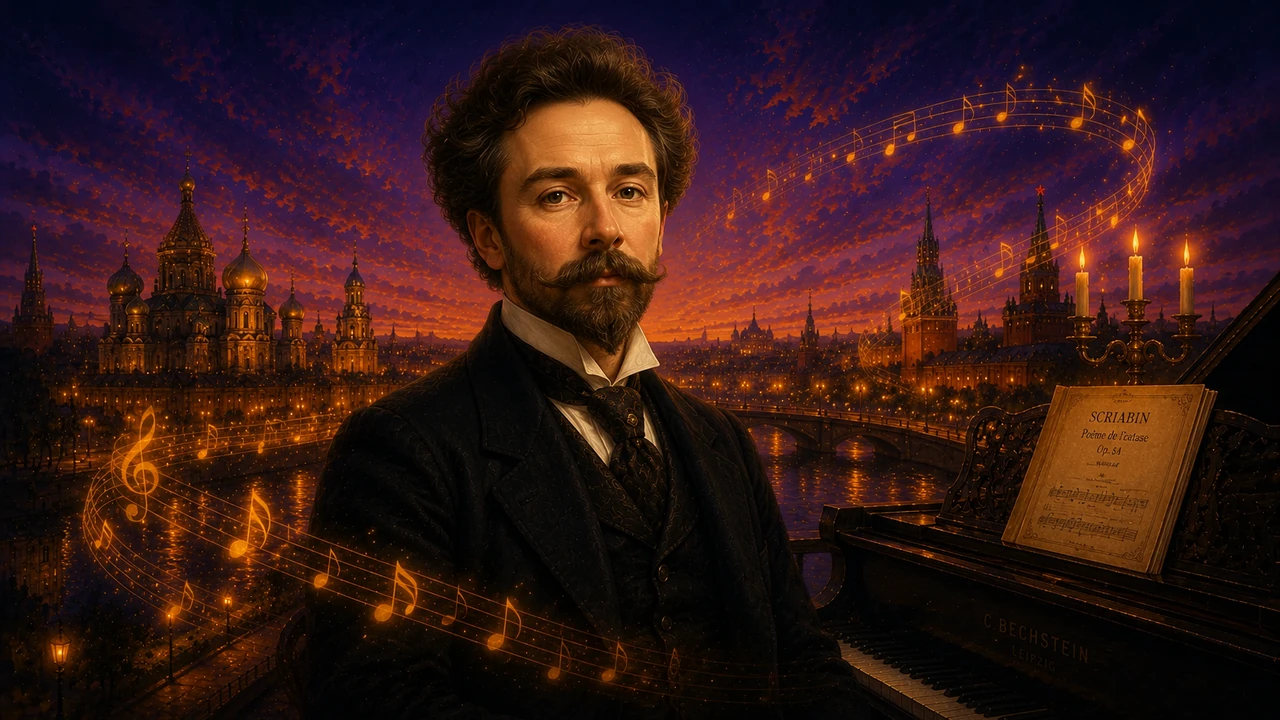
Life and Story
Alexander Scriabin was born in Moscow in 1872 and studied at the Moscow Conservatory, where Sergei Rachmaninoff was among his contemporaries. Scriabin first built his reputation as a pianist and composer of short piano pieces strongly influenced by Chopin. Over time his harmonic language changed dramatically. Later sonatas and orchestral works avoid conventional major-minor relationships and use distinctive chord structures associated with his philosophical and mystical ideas. Scriabin also imagined relationships between musical pitch and color and planned ambitious multimedia projects that were never fully realized. He wrote mainly for piano and orchestra and died unexpectedly in Moscow in 1915 at the age of forty-three.
Musical Style
Early works use Chopin-like textures, lyrical melody and rubato. Later works become harmonically unstable, ecstatic and concentrated, often built around special chord collections rather than ordinary tonal progressions.
Why Are They Important?
Scriabin created one of the most individual transitions from late Romanticism to modernism and influenced composers interested in harmony, symbolism and connections between sound and color.
Why Study This Composer?
Scriabin helps students compare early Romantic phrasing with more modern harmony. His preludes and études develop voicing, flexible rhythm and sensitivity to unusual chord color.
What Can a Student Learn?
Students learn to listen for harmonic color, control voicing in dense chords and recognize that musical tension does not always depend on traditional dominant-tonic resolution.
Era and Contemporaries
Scriabin worked in Russia at the turn of the twentieth century, alongside composers such as Rachmaninoff, but moved toward a much more experimental language.
What to Listen For
Compare an early prelude with a later sonata excerpt. Ask which elements still sound Romantic and which harmonies no longer behave in the way you expect.
Memorable Facts
Featured Works
This section lists important works for reference. A score link appears only when Gamurland has completed both rights and score verification for that work.