
Franz Schubert
Franz Schubert wrote hundreds of songs, piano works, chamber pieces and symphonies in a life of only thirty-one years, becoming one of the key musical bridges from Classical form to Romantic lyricism.
Schubert’s melodies can sound so natural that they seem discovered rather than constructed.
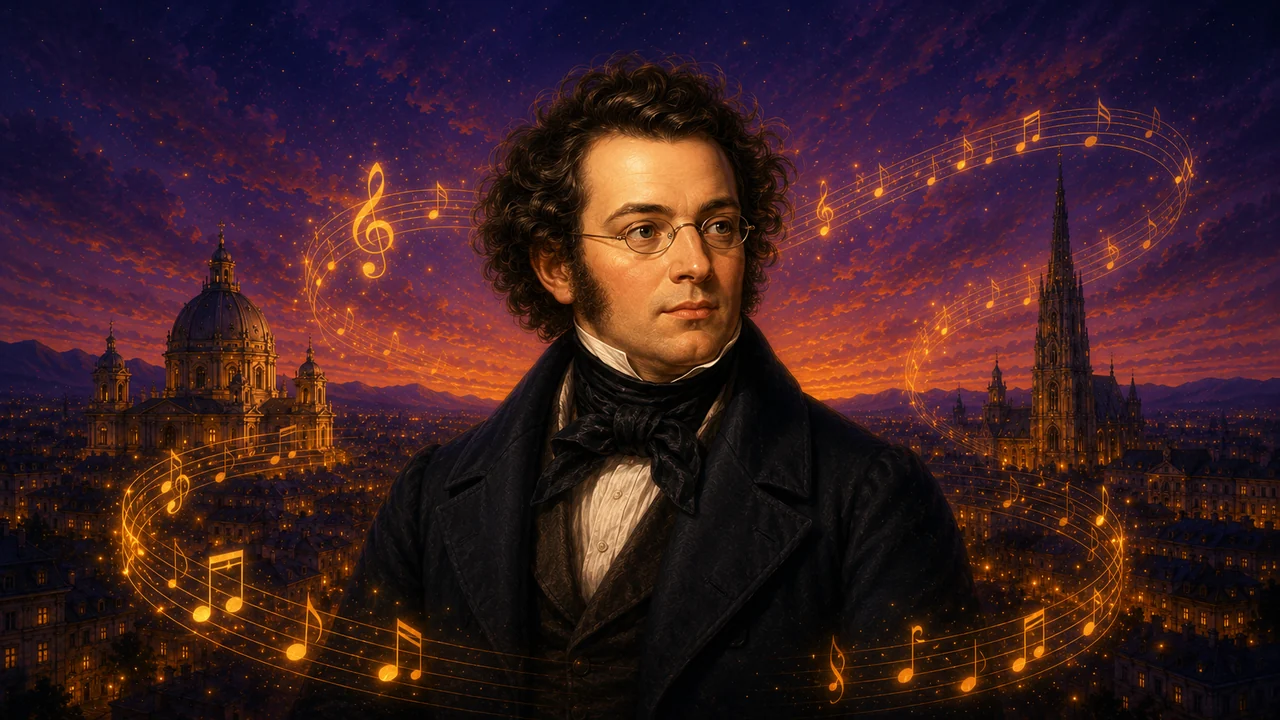
Life and Story
Franz Schubert was born in Vienna in 1797. His father was a schoolteacher, and Schubert learned violin, piano and singing as a child. He became a choirboy in the imperial chapel and received a strong education, later working briefly as a teacher in his father’s school. Composition, however, became the center of his life. Schubert never secured the kind of prestigious long-term court post that supported earlier composers, but he produced music at an extraordinary rate. He wrote more than six hundred Lieder, along with piano pieces, chamber music and symphonies. Friends gathered for informal musical evenings later known as Schubertiades, where his works were performed. Songs such as Erlkönig and Gretchen am Spinnrade show how the piano can actively depict events in a poem rather than merely accompany a singer. Major orchestral works, including the “Unfinished” Symphony, became more widely known after his death. Schubert died in Vienna in 1828.
Musical Style
Melody is central to Schubert’s language, but unexpected harmonic turns can change its emotional meaning. Major and minor may alternate quickly. Piano accompaniments often create visual motion, such as spinning, running or flowing water.
Why Are They Important?
Schubert transformed the German Lied into one of the most important Romantic genres and brought a new lyrical depth to piano and chamber music.
Why Study This Composer?
Schubert develops long legato lines, harmonic listening and the ability to sustain a phrase over many bars. Short dances and character pieces also offer accessible Romantic repertoire.
What Can a Student Learn?
Students learn to think beyond one measure at a time. The melody must keep its direction while accompaniment stays supportive and harmonic changes are heard as part of the emotional story.
Era and Contemporaries
Schubert lived in Vienna during Beethoven’s final years and admired him greatly. He inherited the Classical tradition while moving toward a more intimate Romantic language.
What to Listen For
In Erlkönig, listen to the relentless piano motion and how it creates urgency. In an Impromptu, follow the melody through harmonic changes and notice where the phrase truly takes a breath.
Memorable Facts
Featured Works
This section lists important works for reference. A score link appears only when Gamurland has completed both rights and score verification for that work.