
Ludwig van Beethoven
Ludwig van Beethoven transformed the balanced language of the Classical era through powerful personal expression, large-scale development and rhythmic energy, helping open the path toward Romantic music.
In Beethoven, a tiny rhythmic idea can grow into an entire musical world.
Life and Story
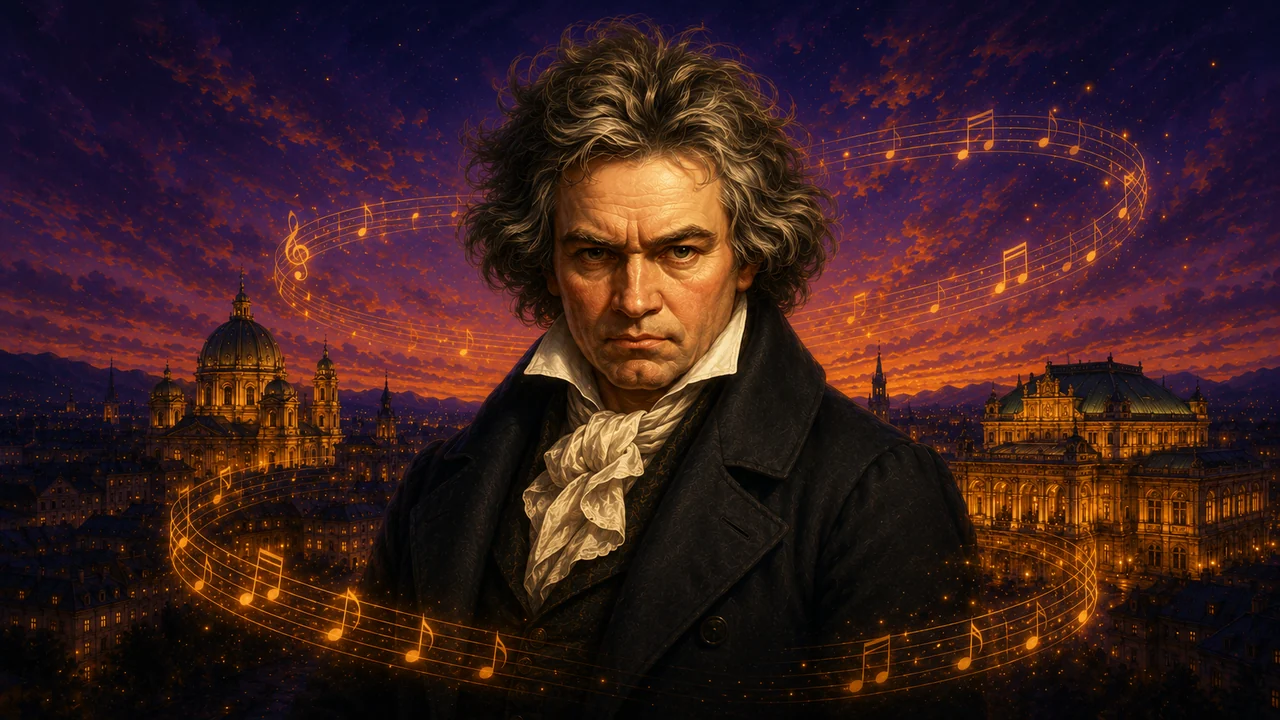
Ludwig van Beethoven was born in Bonn in 1770 into a musical family. He studied keyboard, violin and composition and moved to Vienna in his early twenties, where he quickly gained attention as a pianist and improviser. He studied with musicians including Haydn and absorbed the Classical traditions of Mozart and Haydn, but developed an increasingly individual style. One of the central struggles of his life was progressive hearing loss, which began while he was still a young adult. Although this was devastating for a professional musician, Beethoven continued to compose and produced many of his greatest works after his hearing had seriously declined. The Eroica Symphony, Fifth Symphony, Ninth Symphony, major piano sonatas and late string quartets expanded the scale and expressive ambition of existing forms. He died in Vienna in 1827. Beethoven’s career also symbolizes a changing idea of the composer—from a court servant toward a more independent public artist.
Musical Style
Short motives often drive large structures in Beethoven’s music. Sudden forte-piano contrasts, accents, silences and long crescendos create drama. Early works reflect Classical balance; middle and late works become broader, harmonically bolder and more personal.
Why Are They Important?
Beethoven expanded the expressive possibilities of the symphony, sonata and string quartet. Nineteenth-century composers treated his music as both inspiration and an enormous standard to respond to.
Why Study This Composer?
Beethoven is ideal for developing rhythmic stability, dynamic contrast, long-term musical planning and control of tension. His repertoire ranges from accessible dances and bagatelles to demanding sonatas.
What Can a Student Learn?
Students learn to maintain pulse, shape repeated motifs with purpose and treat silence as part of the phrase. They also learn how to save energy for long climaxes rather than playing strongly all the time.
Era and Contemporaries
Beethoven grew from the Viennese Classical world of Haydn and Mozart but became a central bridge toward Romanticism. Schubert was a younger composer living in Vienna during Beethoven’s final years.
What to Listen For
In Symphony No. 5, follow the famous four-note rhythm and count how many different forms it takes. In a piano sonata, notice how changes in dynamics and silence create tension even before the harmony changes.
Memorable Facts
Featured Works
This section lists important works for reference. A score link appears only when Gamurland has completed both rights and score verification for that work.