
Johann Sebastian Bach
Johann Sebastian Bach was one of the defining composers of the Baroque era, famous for making several independent musical lines work together with extraordinary clarity and purpose.
More than one melody can live at the same time: Bach turned that idea into a complete musical language.
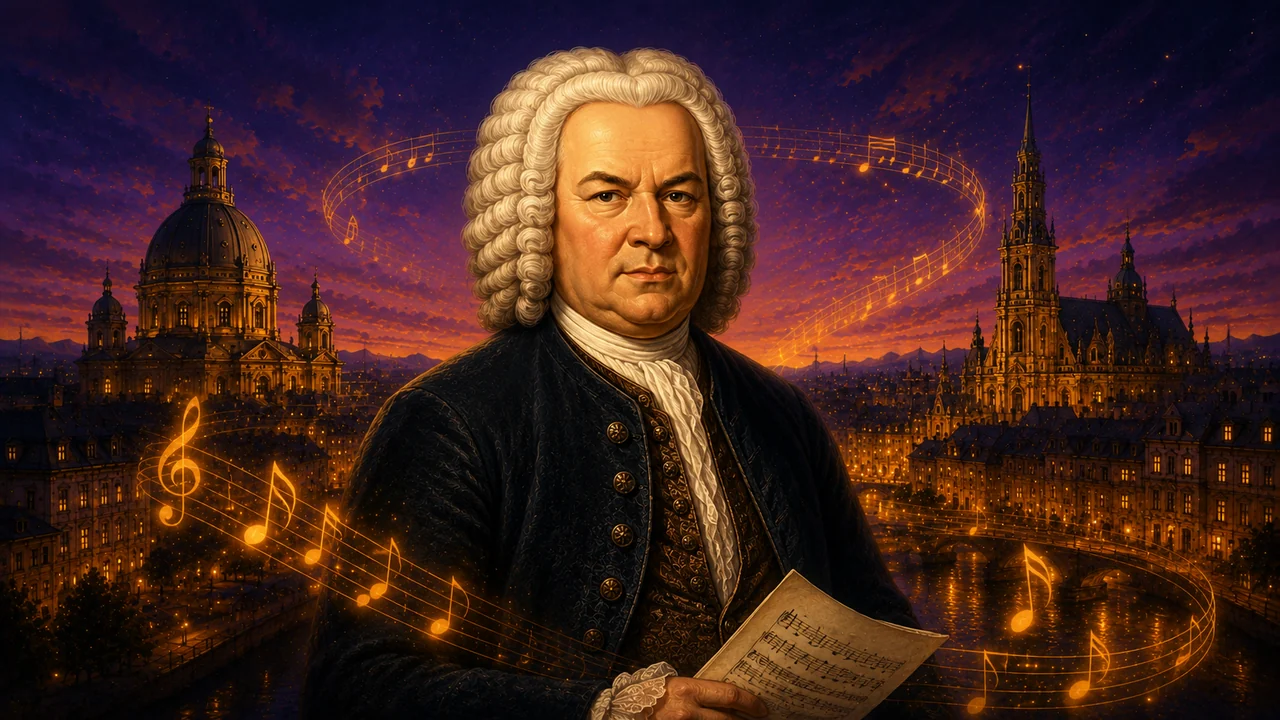
Life and Story
Johann Sebastian Bach was born in Eisenach in 1685 into a large family of professional musicians. He worked as a violinist, organist, teacher and music director in several German cities before spending the last part of his career in Leipzig. There he was responsible for music at major churches, taught students and produced a remarkable amount of new repertoire. During his lifetime Bach was especially admired as an organist and improviser. He wrote cantatas, concertos, suites, keyboard works, chamber music and large sacred compositions. His music did not remain at the center of public concert life immediately after his death, but nineteenth-century musicians helped bring it back to wider attention. Today his works are central to both professional performance and music education. From small pieces in the Anna Magdalena notebooks to inventions, preludes, fugues and the Goldberg Variations, Bach offers students a path from early study to the highest levels of musicianship.
Musical Style
Counterpoint, imitation, sequences and strong harmonic direction are central to Bach’s style. One voice may introduce an idea while another answers it. Dance rhythms appear throughout his suites, and ornaments are part of the musical grammar rather than decoration added at random. Even when the tempo is moderate, the music usually has a clear sense of forward motion.
Why Are They Important?
Bach brought together contrapuntal and harmonic techniques developed over generations and used them with exceptional depth. Mozart, Beethoven, Chopin and many later composers studied his works. His music remains one of the clearest ways to learn how independent lines, harmony and form can cooperate.
Why Study This Composer?
Bach helps learners develop hand independence, steady rhythm, clear phrasing and the ability to hear several voices at once. His music rewards careful listening rather than simply playing the correct notes.
What Can a Student Learn?
A student learns to identify which voice is leading, where phrases begin and end, and how two hands can perform separate musical jobs without losing the overall pulse. This builds coordination, concentration, memory and musical reasoning.
Era and Contemporaries
Bach lived in the late Baroque era alongside Handel, Vivaldi and Telemann. Ornamentation, basso continuo, dance forms and contrapuntal writing were important features of the period. Bach absorbed these traditions and gave them his own powerful structural character.
What to Listen For
First follow the most obvious melody. Then listen again and try to hear a second line underneath or inside it. Notice when a small motif appears in another voice. Once you hear these exchanges, Bach’s music becomes much easier to understand.
Memorable Facts
Featured Works
This section lists important works for reference. A score link appears only when Gamurland has completed both rights and score verification for that work.